 how-to
How to Troubleshoot Tankless Water Heater Error Codes
Table of Contents
- Why Tankless Water Heaters Show Error Codes
- Common Error Codes and What They Mean
- How to Troubleshoot Tankless Water Heater Error Codes: Step-by-Step
- How to Reset Your Unit After an Error Code
- How to Flush a Tankless Water Heater to Clear Sensor Errors
- Tankless Water Heater Maintenance Schedule to Prevent Future Errors
- Tankless Water Heater Repair Cost vs. DIY Fixes
- When to Call a Professional Plumber
- Frequently Asked Questions
Last Updated: September 9, 2026
Why Tankless Water Heaters Show Error Codes
A tankless water heater is a precision appliance that monitors dozens of operating conditions simultaneously. When something falls outside the manufacturer's specified range, the unit's control board locks out the system and displays an error code on the digital screen instead of supplying hot water. This protective shutdown prevents further damage, but it leaves you without hot water until the underlying issue is resolved.
Understanding how to troubleshoot tankless water heater error codes starts with recognizing what these alerts represent. Most codes fall into one of four categories: ignition failure, combustion or venting problems, water flow issues, or sensor and temperature faults.
The good news is that many error codes trace back to routine maintenance gaps rather than major component failures. This guide walks through the most common codes, the step-by-step troubleshooting process, and when a DIY fix is appropriate versus when you need a certified technician.
Common Error Codes and What They Mean
Each manufacturer uses its own alphanumeric system, but the underlying conditions are remarkably consistent across major brands. Here are the error families you are most likely to encounter:
| Error Category | What It Indicates | Common Causes | Typical Fix |
|---|---|---|---|
| Ignition failure | Burner won't light | Gas valve off, spark electrode issue | Verify gas supply, reset unit |
| Flameout | Burner lights then dies | Vent blockage, exhaust recirculation | Check venting, clean combustion chamber |
| Overheating | Outlet-water temperature exceeds limit | Scale buildup on heat exchanger | Flush and descale the unit |
| Water flow sensor fault | Insufficient flow detected | Clogged inlet filter, low water pressure | Clean filter, check supply valve |
| Probe error | Faulty temperature readings | Failed thermistor, loose wiring | Replace sensor or reseat connection |
Since your error code display gives you a specific alphanumeric sequence, check your owner's manual for the exact definition. However, the troubleshooting sequence below applies broadly regardless of whether you see an ignition failure code like 11 or a sensor fault like 76.
How to Troubleshoot Tankless Water Heater Error Codes: Step-by-Step
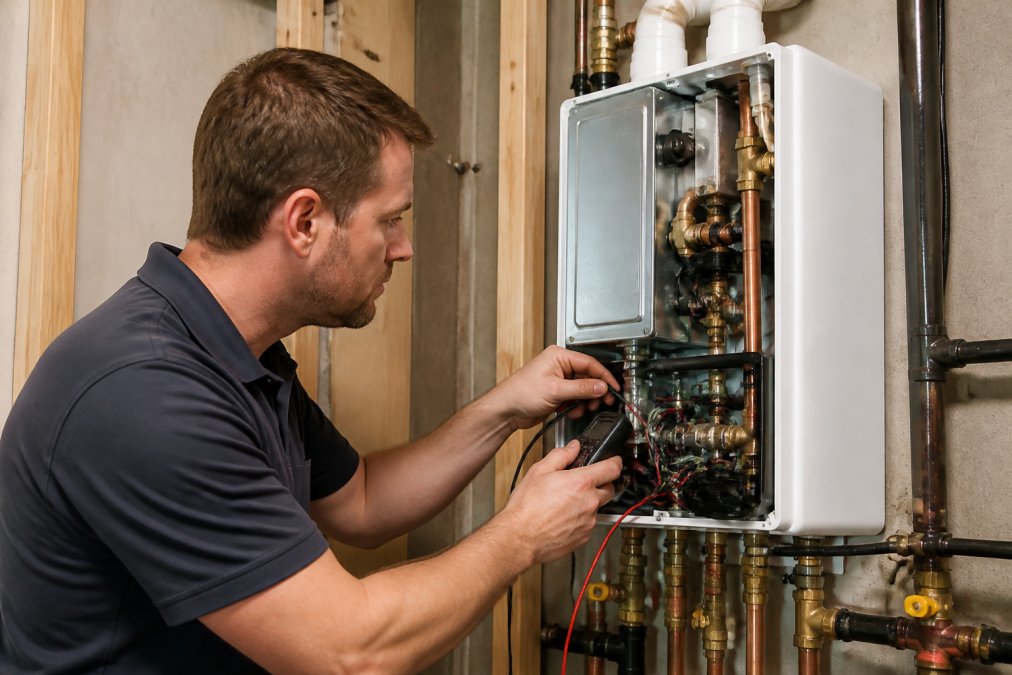
Working through these steps in order resolves most common error codes without needing to call for service. Before you begin, confirm the unit is cool to the touch and that you have a flashlight, a multimeter, and basic hand tools available. Always turn off the gas supply valve and disconnect power at the circuit breaker before opening any access panels.
Step 1: Check Power and Circuit Breaker
The control board needs stable voltage to operate the combustion fan, gas solenoid valve, and sensors. A tripped breaker or loose wiring connection is one of the most common causes of ignition failure codes.
Start by locating the dedicated circuit breaker for the water heater and confirming it is in the ON position. If it tripped, reset it and observe whether the unit powers up normally. Use a multimeter to verify the unit is receiving proper voltage at the terminal block, typically 120V or 240V depending on your model. Check that all ground connections are secure, since a poor ground can cause erratic sensor readings.
Step 2: Verify Gas Supply and Valve Position
An ignition failure error frequently occurs because the gas supply valve is partially closed or the gas line has air in it. Confirm the gas supply valve on the unit is fully open, turned parallel to the pipe. If the unit is new or was recently serviced, air may have entered the line, requiring multiple purge cycles to clear.
Check other gas appliances in the home to determine whether the issue is isolated to the water heater or affects the whole house. If no other appliance works, contact your gas utility provider. For propane systems, verify the tank has sufficient fuel, since low tank levels produce weak burner performance and flameout errors.
Step 3: Inspect Venting and Exhaust Blockages
Tankless units exhaust combustion gases through a dedicated venting system. A blockage here triggers both flameout and overheating codes because the combustion fan cannot maintain proper airflow. Inspect the vent termination outside the home for bird nests, debris, or heavy snow accumulation during winter months.
Check the flue inlet and exhaust pipes for signs of disconnection or corrosion along their entire run. Ensure venting components maintain the manufacturer's required clearance from combustible materials. A common mistake is storing items near the vent termination, which restricts exhaust flow and causes the unit to shut down intermittently.
Step 4: Test Water Flow and Inlet Filter
The water flow sensor activates the burner only when it detects sufficient flow, typically around 0.5 gallons per minute (energy.gov). Low flow prevents ignition entirely, producing an error code even though the heater itself is functional. Close the isolation valves and remove the inlet water filter, cleaning it if debris or scale is visible.
Verify that the cold water supply valve is fully open and check for kinks or restrictions in the supply line. If you have a whole-house filtration system, confirm the filter cartridge is not clogged, as this reduces pressure to the water heater. Sediment in the supply line is a leading cause of flow sensor faults, which is why a maintenance flush is so important.
How to Reset Your Unit After an Error Code
Once you have addressed the underlying condition, most units require a manual reset to clear the error code and restart normal operation. The reset button is typically located behind the front access panel, near the control board. Press and hold the reset button for three to five seconds, or until the display clears, then release it.
If your unit does not have a physical reset button, power cycling the unit accomplishes the same result. Turn off the circuit breaker, wait 60 seconds, and turn it back on. This allows the control board to complete a full diagnostic cycle. Watch the display as the unit attempts to ignite; a successful restart shows the burner flame and rising outlet-water temperature within 30 seconds.
How to Flush a Tankless Water Heater to Clear Sensor Errors
Scale buildup is the primary reason tankless water heaters develop overheating and sensor-related error codes, particularly in areas with hard water. A vinegar or descaling solution flush dissolves mineral deposits inside the heat exchanger, restoring proper heat transfer and water flow. Most manufacturers recommend this procedure annually, though homes with very hard water may need it every six months (homedepot.com).
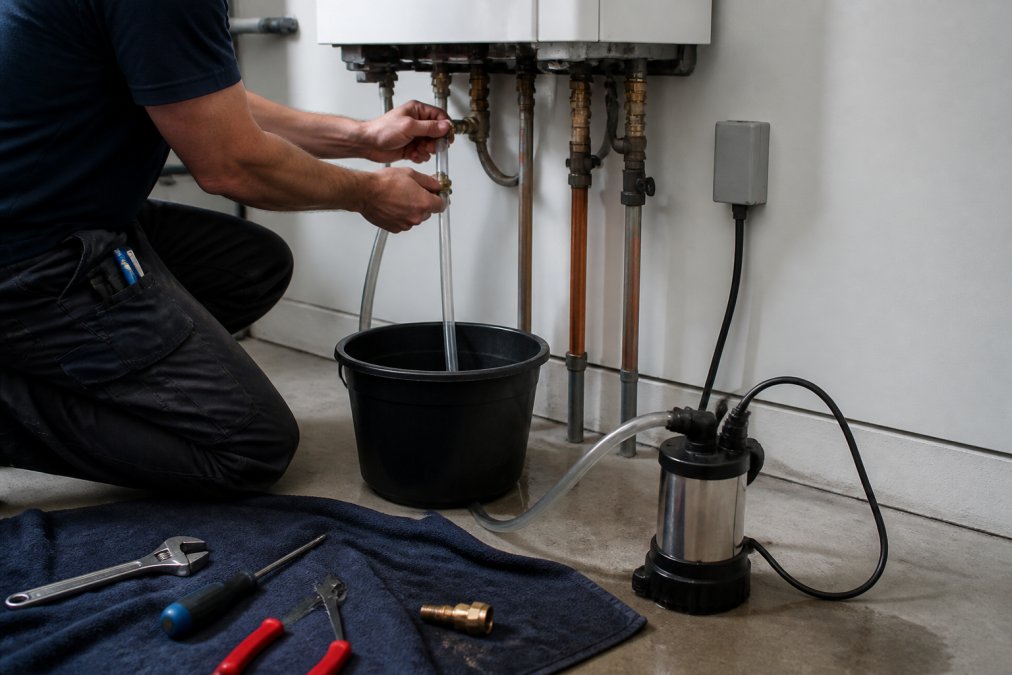
To flush the unit, you need a submersible pump, two hoses, a five-gallon bucket, and white vinegar or a commercial descaling solution. Close both isolation valves, disconnect the inlet and outlet service ports, and connect your hoses to create a closed loop between the pump and the heat exchanger. Run the pump for 45 to 60 minutes, allowing the solution to circulate through the system.
After flushing, disconnect the pump and reconnect the service ports. Open the isolation valves and run hot water for several minutes to clear any remaining solution. This process removes the scale that causes the outlet-water temperature probe to misread and the thermal fuse to trip, clearing many persistent error codes without any parts replacement.
Tankless Water Heater Maintenance Schedule to Prevent Future Errors
A regular maintenance schedule is the most effective way to prevent tankless water heater error codes from appearing in the first place. Most error conditions develop gradually, and routine inspection catches them before they cause a lockout. Following a consistent schedule extends the lifespan of the heat exchanger, combustion fan, and gas solenoid valve.
| Maintenance Task | Recommended Frequency | What It Prevents |
|---|---|---|
| Flush and descale heat exchanger | Annually (twice yearly for hard water) | Overheating codes, scale buildup |
| Clean inlet water filter | Every 3-6 months | Flow sensor faults, low pressure |
| Inspect vent termination for blockage | Seasonally, especially before winter | Flameout, exhaust blockage codes |
| Check gas supply valve and connections | Annually | Ignition failure errors |
| Verify error code history and test sensors | Annually during service | Unexpected lockouts |
A homeowner can handle the inlet filter cleaning and vent inspection without special tools. The descaling flush requires a pump and some familiarity with the service ports, but many DIY-oriented owners complete it successfully. For those who prefer professional service, a technician can perform the full maintenance routine, including combustion analysis and sensor testing, in about an hour.
Tankless Water Heater Repair Cost vs. DIY Fixes
The decision to attempt a DIY repair versus calling a professional often comes down to the nature of the error code and your comfort level with gas appliances. Simple fixes like cleaning the inlet filter, resetting the unit, or clearing a vent blockage cost nothing but your time. These tasks are safe for most homeowners and resolve a substantial portion of routine error codes.
Component-level repairs are a different matter. Replacing a gas solenoid valve, combustion fan, or heat exchanger requires specialized tools and a deep understanding of the unit's operation. Incorrect installation of gas components creates a safety hazard, including the risk of carbon monoxide exposure. Error codes that persist after basic troubleshooting typically indicate a failed component that needs professional diagnosis.
When weighing tankless water heater repair cost against DIY, consider the value of a correct first-time fix. A certified technician arrives with diagnostic equipment and commonly replaced parts on hand, often resolving the issue in a single visit. For homeowners in Beacon, NY and the Hudson Valley, Water Heater Express LLC offers same-day service and a Price Match Guarantee.
When to Call a Professional Plumber
If you have worked through the troubleshooting steps above and the error code persists, professional diagnosis is the right next step. Repeated ignition failure, gas odors, unusual noises from the combustion chamber, or visible water leaks all warrant immediate attention from a licensed technician. Continuing to operate a unit with a combustion fault risks property damage and creates a carbon monoxide hazard.
Gas appliance repair is regulated for good reason. A certified technician verifies proper combustion, checks the venting system meets code, and confirms safe operation before leaving your home (csia.org). Attempting to repair gas components without proper training voids warranties and can create dangerous conditions.
Professional service also provides peace of mind that the repair addresses the root cause, not just the symptom. Flexible payment options make unexpected repairs manageable, and 24/7 availability means help is there when your tankless unit fails.
Tankless water heater error codes can seem intimidating, but most trace back to a handful of preventable conditions: airflow restrictions, scale buildup, or supply issues. Working through the troubleshooting steps in order resolves many problems without a service call. When the fix exceeds a basic DIY repair, a certified technician protects your safety and your investment. Get started with Water Heater Express LLC and restore reliable hot water with same-day service from certified, licensed technicians. BOOK ONLINE TODAY!
Frequently Asked Questions
What is the most common problem with tankless water heaters?
Scale buildup from hard water is the most frequent cause of error codes. Mineral deposits coat the heat exchanger and water flow sensor, which triggers overheating or flow-related codes. Flushing the unit with a descaling solution, often vinegar or citric acid, clears the buildup and restores normal operation. This is why regular maintenance is critical, especially in areas with hard water.
How do I clear an error code on my tankless water heater?
First, try a simple power cycle. Turn off the unit's power at the circuit breaker, wait 60 seconds, and turn it back on. If the code returns, consult your manual to identify the specific fault. Many codes, such as ignition failure or flameout, require you to check the gas supply, venting, or water flow before resetting the system. If the error persists after troubleshooting, it may indicate a part failure needing professional repair.
Can I fix a tankless water heater error code myself?
Yes, you can safely handle several causes: a tripped circuit breaker, a closed gas supply valve, a blocked vent, or a clogged inlet filter. Flushing the system to remove scale is another DIY task. However, if the code involves the combustion fan, gas solenoid valve, or circuit board, stop and call a certified technician. Working on gas components carries serious risks, and a professional diagnosis prevents repeat failures.